
Rodent Control in Denton, TX
Roof rats are the dominant attic rodent across Denton and the rest of Denton County. Pecan and oak canopies along older streets give them highway access to rooflines.
- Fast dispatch
- Same-day where available
- DFW-wide coverage
Rodent Control in Denton, TX
Rodent Control is dispatched fast across Denton, TX, with same-day windows sometimes available depending on the local provider's route. Coverage spans 11 Denton ZIP codes in Denton County. Denton County stretches from the urban core out to Lake Lewisville and the rural northwest.
Pest call from a Denton address usually starts one of three ways: a sighting in the kitchen, evidence in the attic, or a swarm in the yard. Rodent Control covers a defined subset — house mice, roof rats, norway rats — and this page lays out the inspection-to-resolution process for a Denton home.
Denton coverage runs ZIP codes 76201, 76202, 76203, 76204, 76205, 76206, 76207, 76208, 76209, 76210, and 76226 across Denton County, with a population near 438,000 and a low-density build pattern. The local profile leans toward fire ant, carpenter ant, subterranean termite, roof rat. Denton County stretches from the urban core out to Lake Lewisville and the rural northwest. Lakeside mosquito pressure is heavy; older Denton city wood-frame housing keeps carpenter ant volume up; newer master-planned developments drive termite swarm calls. Fire ants dominate yards across the county.
Coverage spans Denton neighborhoods including Robson Ranch, Hickory Hills, North Lakes, Old Town.
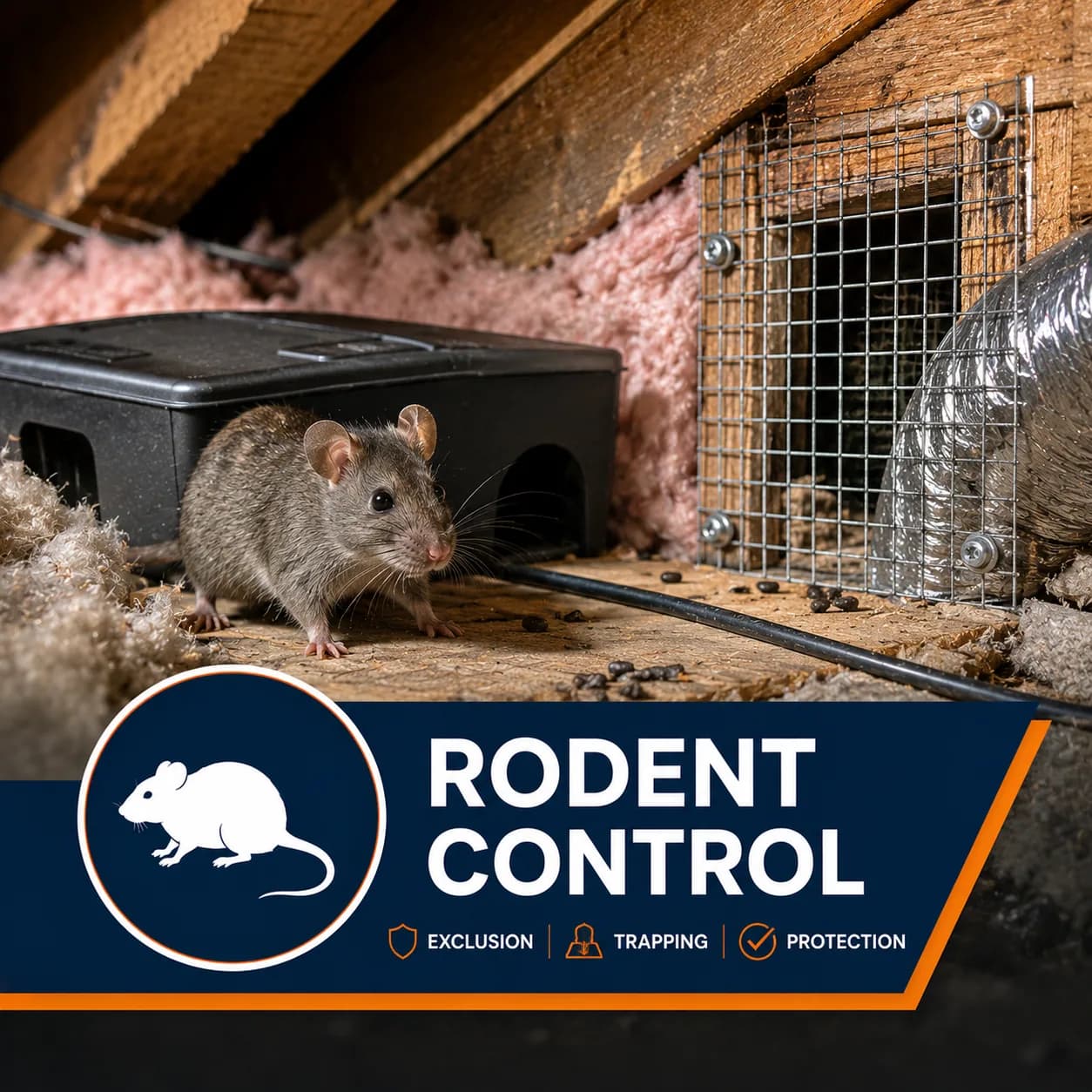
What a Rodent Visit Typically Looks Like in Denton
Most providers in Denton open with an inspection; targeted treatment follows once the technician confirms what's active and where. For rodent control, the typical workflow runs: attic, crawlspace, and exterior inspection to find entry points; hardware-cloth and copper-mesh exclusion of every gap larger than 0.25 inch; snap-trap and tamper-resistant station deployment per ipm protocol; two-week follow-up to confirm zero activity, then ongoing exterior stations. The exact protocol, products, and follow-up cadence are determined by the independent provider that takes your call.
Seasonal Pressure in Denton County
House mice reproduce in utility rooms and pantries year-round.
Pests Covered
- House mice
- Roof rats
- Norway rats
Signs to Watch For
- Droppings along baseboards or in pantry
- Scratching or rolling sounds in the attic after sundown
- Gnaw marks on wood, drywall, or food packaging
- Greasy rub marks along utility lines
Same-day windows are sometimes available for Denton addresses depending on the provider's route. Call the number above and the dispatcher will confirm the next window.
Rodent background reading
Denton Service Area
Coverage spans Denton — ZIP 76201, 76202, 76203, 76204, 76205, 76206, 76207, 76208, 76209, 76210, and 76226.
Rodent in Nearby Cities
Other Services in Denton
Rodent FAQs — Denton, TX
Is there anything I need to do before the technician arrives?
For most Rodent Control visits, no prep is required. For bed bug heat treatments, prep instructions go out 48 hours ahead. For roach jobs, the technician asks for access to under-sink cabinets and behind appliances; clearing those areas in advance speeds up the visit.
Do you treat ZIP codes beyond Denton?
Yes. The crew covers Denton and surrounding Denton County ZIP codes, plus neighboring cities — the page footer lists nearby coverage. If the address falls outside the standard radius the agent confirms scheduling at booking.
What does the technician do during the visit?
Inspection first, then targeted treatment. For a typical Rodent Control appointment at a Denton home, that means 10 to 20 minutes walking the property, 30 to 60 minutes treating interior and exterior, and a few minutes documenting findings and next-visit recommendations. Total visit length runs 45 to 90 minutes depending on property size.
Are products applied directly to food prep areas?
No. Treatments in kitchens go into cracks, crevices, and voids — never on counters or food-contact surfaces. Gel baits are placed inside cabinet hinges and behind appliances where pests travel but food does not.
Are bait stations enough on their own?
No. Bait stations alone do not solve a rodent problem in a Denton attic. The fix is exclusion — sealing every entry point larger than a quarter inch — combined with snap-trap deployment inside, then exterior stations to suppress reintroduction. Skip exclusion and the rodents come back.